
消息

Plastic Pall Ring Packing: PP, RPP & CPVC for Absorption & Scrubbing

主页 消息

Plastic Pall Ring Packing: PP, RPP & CPVC for Absorption & Scrubbing

Plastic Pall Ring Packing: PP, RPP & CPVC for Absorption & Scrubbing
September 10, 2026


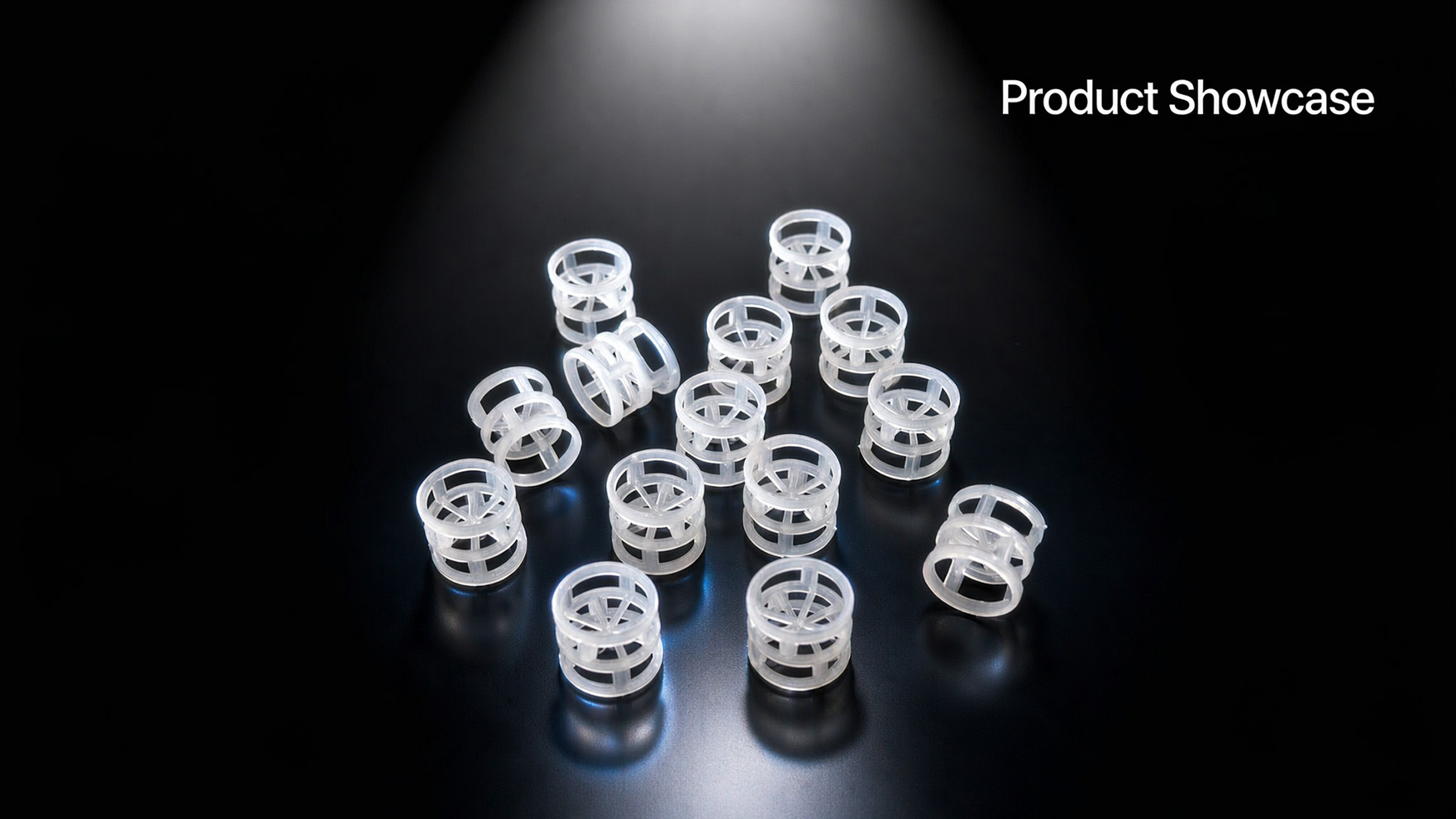
Plastic Pall Rings in PP, RPP, CPVC, and PVDF materials for absorption towers and gas scrubbing

Figure 1: Plastic Pall Rings — PP, RPP, CPVC, and PVDF variants for corrosive service absorption and scrubbing.

Plastic Pall Ring Packing: PP, RPP & CPVC for Absorption & Scrubbing

Engineering Brief: When your tower runs below 100°C and handles corrosive aqueous streams, metal packings are overkill — and will corrode anyway. Plastic Pall Rings in PP, RPP, CPVC, and PVDF deliver void fractions above 90%, low pressure drop, and complete corrosion immunity at a fraction of the cost. Here's the complete specification.

1. What Is a Plastic Pall Ring?

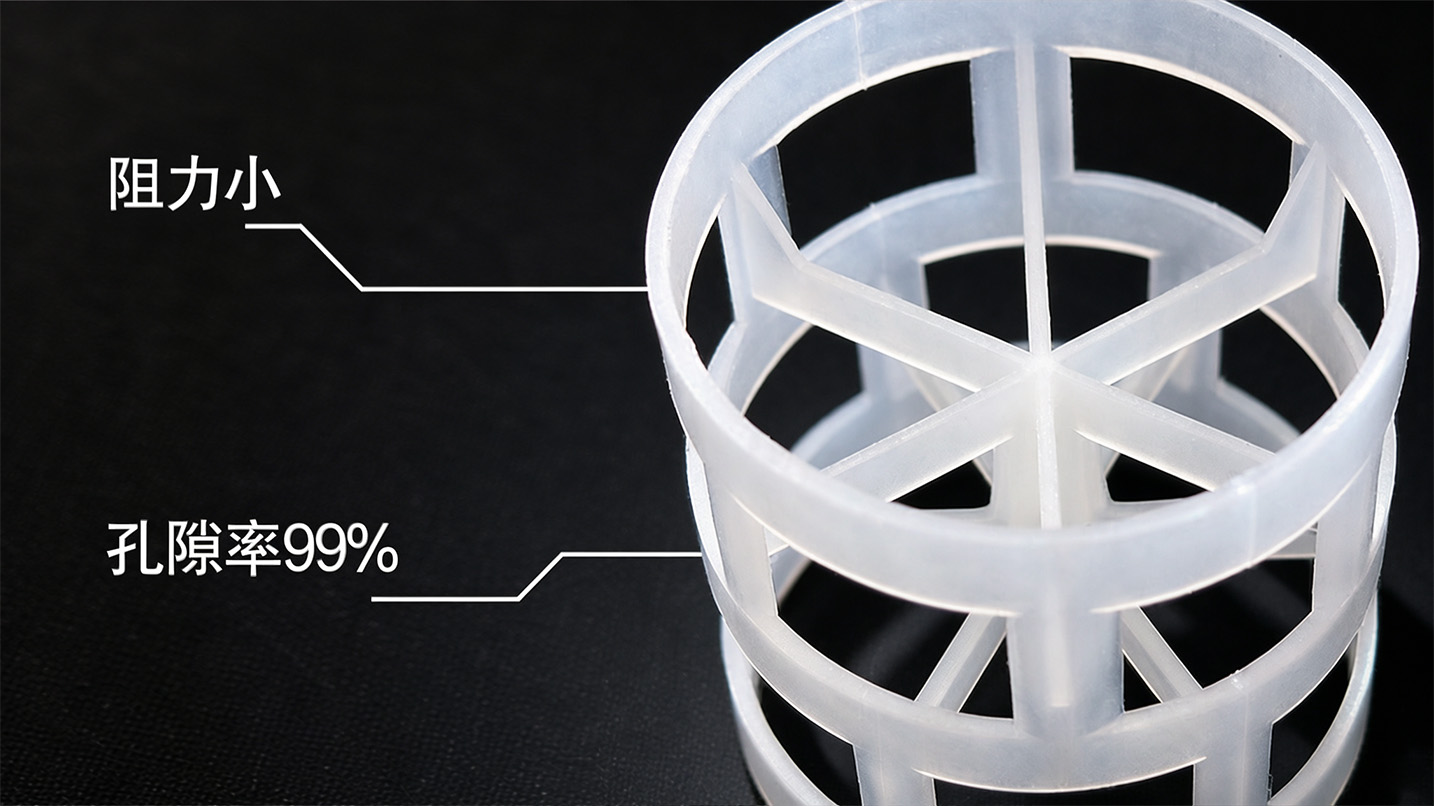
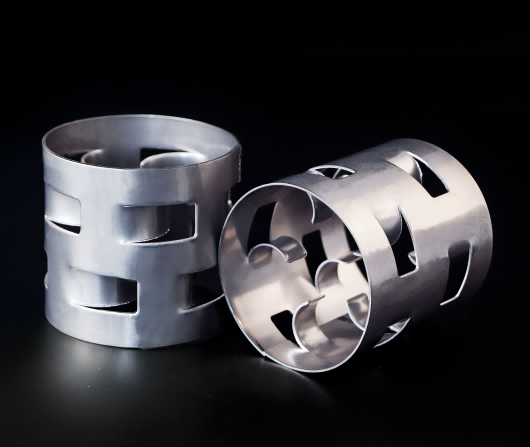
The Pall Ring is the most widely used random tower packing in the world. It evolved from the Raschig ring: while retaining the cylindrical shape (height equals diameter), its wall is punched with two rows of windows, and the resulting tabs are bent inward toward the center . This simple geometric change transforms performance — the windows create internal wetting surfaces and open gas pathways that eliminate the severe channeling and high pressure drop that plague plain Raschig rings .

When molded from thermoplastics (PP, RPP, PVC, CPVC, PVDF), the Pall Ring becomes a lightweight, corrosion-proof, and economical random packing suitable for absorption, scrubbing, cooling, and stripping of non-oxidizing corrosive liquids and gases .

Close-up of plastic Pall Ring showing punched windows and inward-bent fingers that create internal wetting surfaces

Figure 2: Punched windows and inward-bent fingers create internal wetting surfaces and open gas pathways.

2. Technical Specifications (All Sizes)

The following data applies to standard PP Pall Rings. Other materials (RPP, PVC, CPVC, PVDF) share the same geometric dimensions, with bulk density varying by polymer density .

Size D×H×T (mm) Surface Area (m²/m³) Void Fraction (%) Bulk Number (pcs/m³) Bulk Density (kg/m³)
16 × 16 × 1.0 299 90.0 214,000 105
25 × 25 × 1.2 219 93.4 51,900 75
38 × 38 × 1.4 146 94.5 13,800 68
50 × 50 × 1.5 109 94.9 6,500 56
76 × 76 × 2.6 71 95.1 1,830 52

Data compiled from industry standard datasheets (geometric values; bulk density shown for PP, varies by material density). Custom sizes (10/13/89/100mm) and wall thicknesses available on request.

3. Material Selection: PP vs RPP vs CPVC vs PVDF

Choosing the right polymer is the single most important decision. The wrong material will warp, crack, or leach — use this table to match chemistry and temperature :

Material Max Temp (continuous) Density (g/cm³) Chemical Resistance Typical Application
PP (Polypropylene) 100°C 0.89–0.91 Excellent general-purpose Water treatment, general scrubbing, cooling
RPP (Reinforced PP) 120°C 0.95–1.05 Higher strength, retains shape Hot alkaline scrubbing, deeper beds
PVC (Polyvinyl Chloride) 60°C 1.38–1.45 Strong acids (H2SO4, HCl) Chlor-alkali, HCl absorption (low temp)
CPVC (Chlorinated PVC) 90°C 1.45–1.58 Hot acids and oxidizing media Hot acid gas scrubbing, FGD
PVDF (Kynar) 150°C 1.75–1.78 Superior (halogens, HF, solvents) Chlorine, HF, ultra-pure, semiconductors
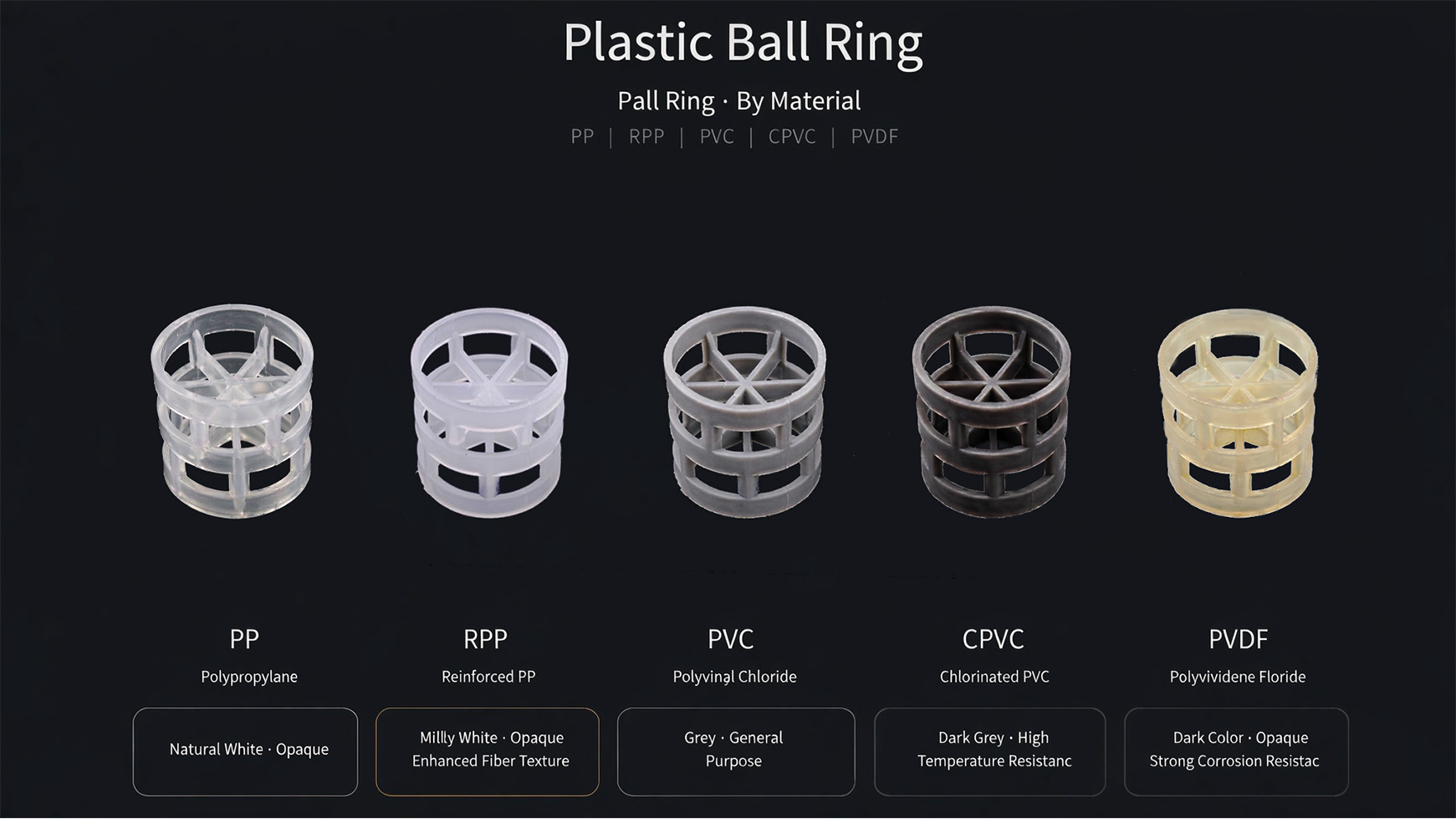
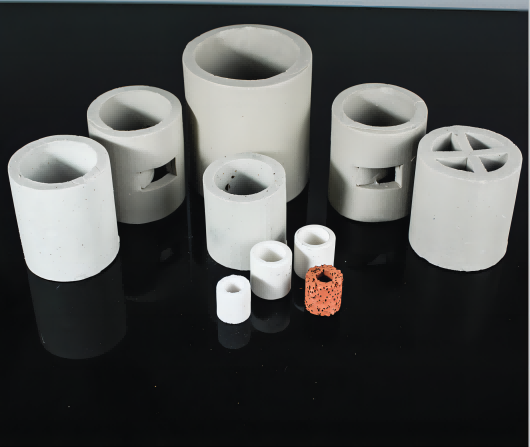
Comparison of five plastic Pall Ring materials: white PP and RPP, gray PVC and CPVC, and opaque PVDF

Figure 3: Material selection — white PP/RPP, gray PVC/CPVC, and opaque PVDF for aggressive service.

4. Why Choose Plastic Pall Rings?

Core Performance Advantages

  • Complete Corrosion Immunity: Polymers do not rust or corrode — ideal for salts, acids, alkalis, and brine where metal packings fail .
  • Low Pressure Drop: Void fractions of 90–95% minimize gas-flow resistance, reducing fan and blower energy .
  • High Mass Transfer Efficiency: Windows and fingers promote uniform liquid distribution, reducing HETP vs. Raschig rings .
  • Lightweight: Bulk density of just 52–105 kg/m³ (PP) — roughly one-fifth of ceramic packings — minimizing tower support requirements .
  • Low Cost: Injection-molded thermoplastics offer the lowest installed cost per unit of separation among all corrosion-resistant packings .

5. Primary Applications

  • • Acid Gas Absorption: HCl, SO2, SO3, H2S, Cl2, and NOx scrubbing — the largest single application .
  • • Flue Gas Desulfurization (FGD): Wet limestone SO2 removal in power plants and incinerators (CPVC or RPP at elevated temperature) .
  • • Wastewater Treatment: Ammonia and VOC stripping, aeration, deodorization towers .
  • • Cooling & Humidification: Counter-current cooling towers and gas conditioning .
  • • Chemical Recovery: Solvent recovery, acid concentration, and brine dechlorination.
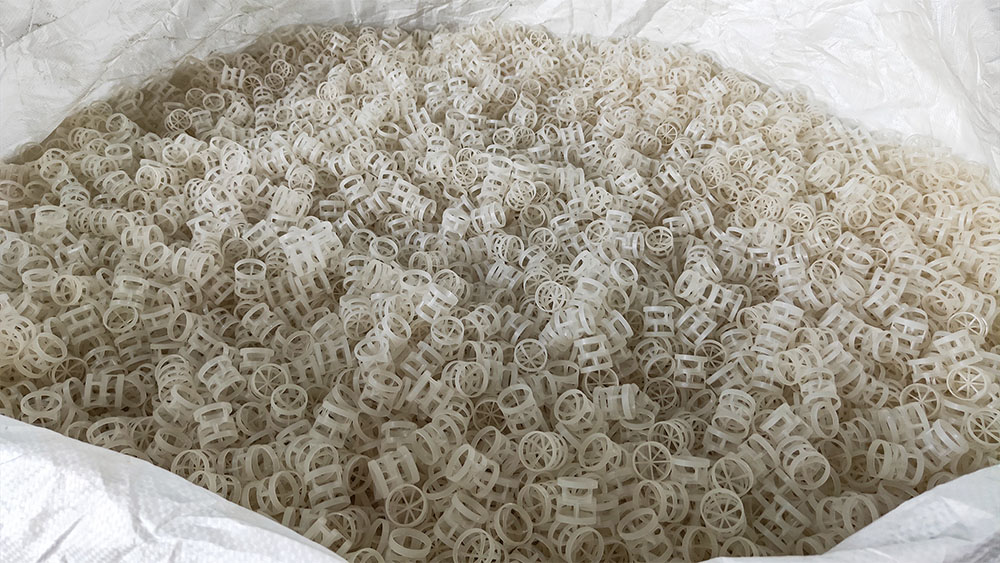
Plastic Pall Rings installed in an acid gas scrubber tower for HCl and SO2 absorption

Figure 4: Plastic Pall Rings (PP) installed in an acid gas scrubber for HCl and SO2 absorption.

6. Plastic vs Metal vs Ceramic Pall Rings

Factor Plastic Metal (SS316L) Ceramic
Max Temperature 60–150°C ~400°C ~800°C
Corrosion Resistance Excellent Moderate Good (acid)
Bulk Density (kg/m³) 52–105 ~400 ~700
Relative Cost Low High Medium
Best For Corrosive aqueous, low–mid temp High temp, hydrocarbons High temp, strong acid

7. Installation Guidelines

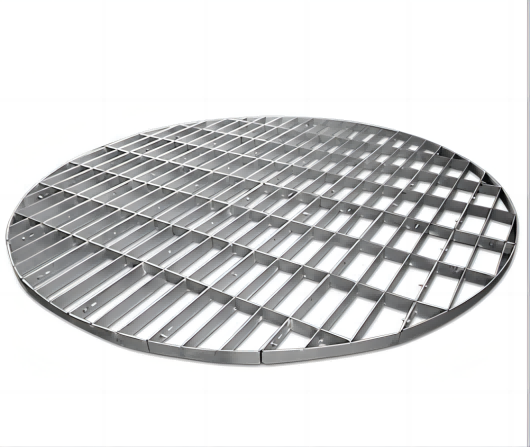
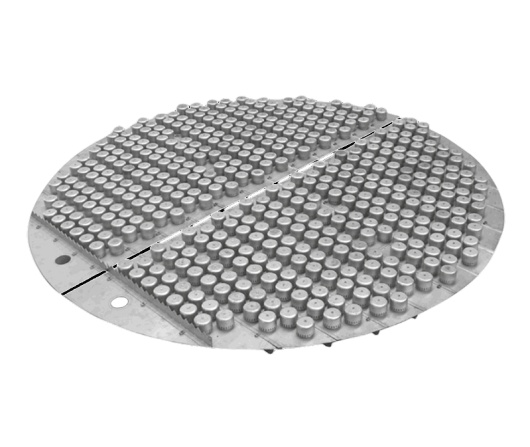
  • Support Grid: Use a camel hump support grid or perforated plate with openings ≤ 60% of ring diameter to prevent fall-through.
  • Uniform Loading: Pour evenly across the tower cross-section; do not dump from one point. Never stand directly on the packing bed — use a spreader board .
  • Bed Limiter: Install a hold-down plate for beds subject to high gas velocity or vacuum. See our Bed Limiter guide.
  • Liquid Distribution: For beds taller than 3–5 m, install collectors and redistributors. See our Collector & Redistributor guide.
  • Pre-Wetting: Always wet the bed before introducing gas to prevent dry channeling and achieve design efficiency immediately.

8. Quick FAQ

Q: Which material should I choose for HCl gas absorption?

A: For dilute HCl at room temperature, PP is the economical choice. For concentrated or warm HCl, use CPVC (to 90°C) or PVDF (to 150°C). PVC is also excellent but limited to 60°C. See our material selection guide for chloride thresholds.

Q: Can plastic Pall Rings handle hot caustic (NaOH) service?

A: PP and RPP resist caustic well up to their temperature limits (100°C and 120°C respectively). Avoid PVC and CPVC in strong alkali — they degrade. For hot concentrated NaOH above 120°C, consider metal or ceramic packings.

Q: How much packing do I need for my tower?

A: Quantity (pcs) = Tower Cross-Sectional Area × Bed Height × Bulk Number (from table). Example: a 2 m ID tower with 3 m bed height of 38mm PP rings: π × 1.0² × 3 × 13,800 ≈ 130,100 pcs. Contact us with your tower dimensions for a precise quote.

Request Plastic Pall Rings for Your Project

FXSINO supplies Plastic Pall Rings in PP, RPP, PVC, CPVC, and PVDF in all standard sizes (16/25/38/50/76mm), with optional carbon-filled PP for anti-static service. Every order ships with material certificates and dimensional inspection reports. We also supply matched support grids and liquid distributors for complete tower packages.

Contact FXSINO: jackieqiu9202@gmail.com | +86 18507999558

留言

留言
如果您对我们的产品感兴趣并想了解更多详情,请在此留言,我们会尽快回复您。
提交

主页

产品

whatsApp

接触